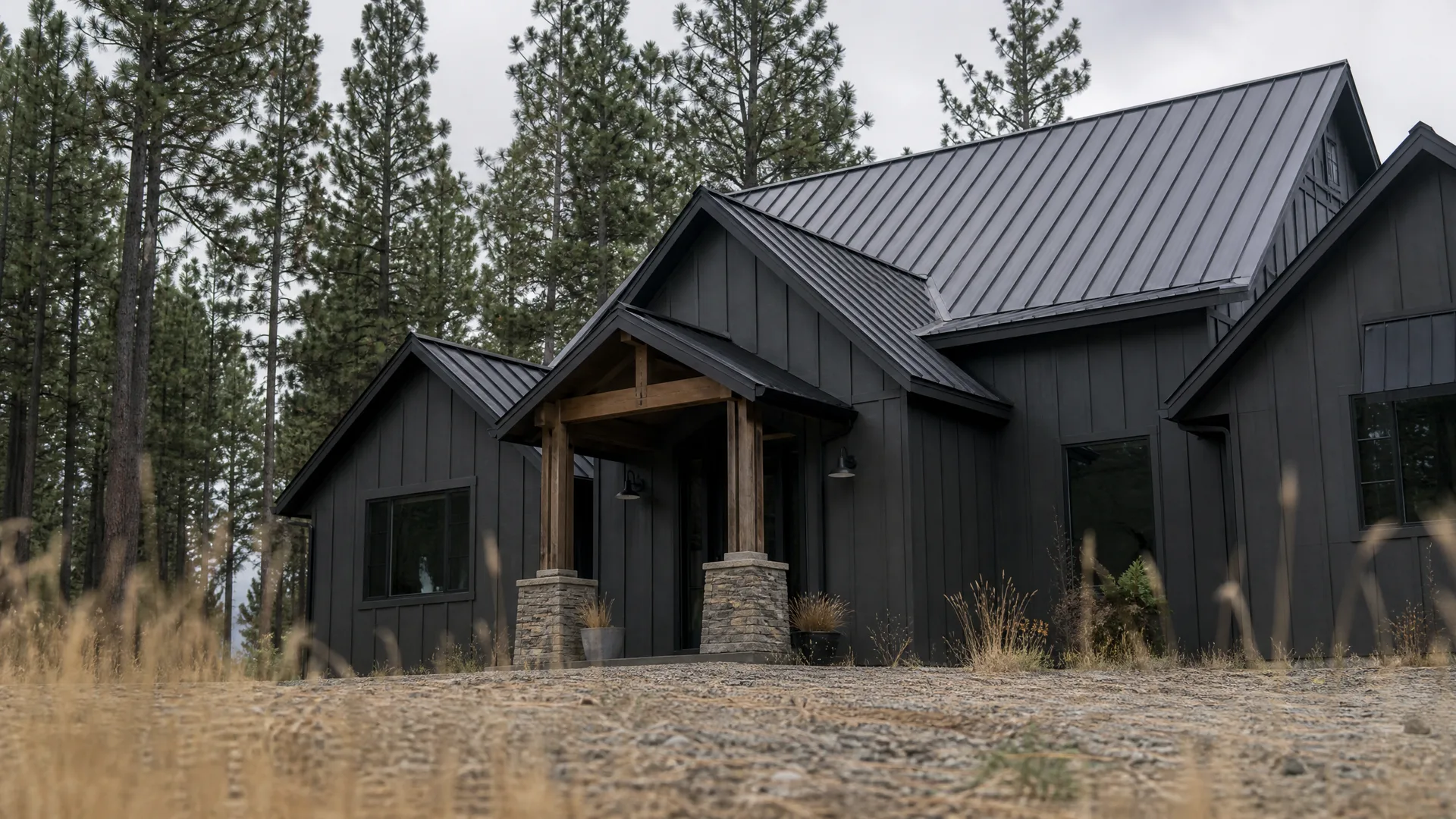





A single-story black board-and-batten house with a dark standing-seam metal roof, timber entry porch posts on stone bases, set among tall pine trees with dry grass in the foreground under an overcast sky.

Heat Pump Installation in Omak, WA

Tell us about the job

Takes about a minute. No obligation.

New system or replacementHeat PumpOkanogan County, WA
Step 1 of 2

What ZIP code is the job in?

A standard heat pump, sized right for your house, is what most homes in Omak need. Nothing about running one here calls for oversizing it or stepping up to a pricier tier. Washington electricity ran 11.90 cents per kilowatt-hour in 2024, cheap enough that a properly matched system keeps costs reasonable without added capacity. The contractor sizing your install will size it to your house, not to the weather.

10 months
September through June, your system heats
19°F
the average winter night it heats against
74°F
the average summer afternoon it cools against
Isometric line illustration of a cutaway single-story house showing interior ductwork, an indoor air handler unit, and an outdoor condenser connected by refrigerant lines, with a dark shingled roof.

Half the homes in Okanogan County were built in 1982 or earlier.

A heat pump sized for your square footage works the same whether your house is older or newer.

Get it in before September, while it's still your choice

Heat runs September through June
38 damaging wind events from 2015 to 2024
243 winter storms from 2015 to 2024
Most homes here already run on electricity73.7% of homes in Okanogan County heat with electricity, so a heat pump matches what's already there.

Okanogan County sits in climate zone 5B, a cool zone where winter heating is the bigger job for any system here. Any new split-system heat pump has to meet federal minimums set for this. That means 14.3 SEER2 for cooling and 7.5 HSPF2 for heating, as a floor rather than a feature. That floor narrows down which models a contractor can offer you. A federal tax credit is also available for qualifying heat pumps, which can offset part of what you pay. Both the standard and the credit apply before you get to picking a brand or a size.

Go with the standard fit

A standard size and efficiency fit fine here. There's no local reason to go bigger or pricier.

Find a contractor
A white mini-split heat pump outdoor unit mounted on a concrete pad beside a gray-sided house, surrounded by gravel and green shrubs.

A long winter, not a hard one

Winters here run cold, with overnight lows averaging 19°F across December through February, and that's the season a heat pump spends most of its hours working. None of that wears the equipment down the way a hard freeze-thaw cycle or constant heavy loads would elsewhere. A heat pump moves heat rather than burning fuel to make it, and steady running through a cold season is ordinary work for it, not strain. What shortens its life is a skipped filter change or a refrigerant leak left alone, not the months on the clock.

Ask for the load calculation, not a guess off square footage

A contractor should walk the house, check the windows and insulation, and run a room by room load calculation before quoting equipment. A number pulled from square footage alone misses what the house actually loses in heat. Ask to see the calculation, not just the result.
Ask how the outdoor unit performs at low temperatures

Every heat pump loses some capacity as the outdoor temperature drops, but models differ in how much they lose and how they make up the gap. Ask what the unit's rated output is at a low outdoor temperature compared to its rated output at mid range, and what kicks in if the heat pump can't keep up on the coldest nights.

The equipment itself is only part of what you're paying for. A straightforward swap, same location, same power supply, existing ductwork in good shape, is a lot less work than a first time install where none of that exists yet. Running new electrical to the outdoor unit, replacing ductwork that leaks or was sized for a different system, or mounting multiple indoor heads for a ductless setup all add labor and materials on top of the unit price. The brand and tier matter too, since a unit that holds more of its capacity at low temperatures costs more than one that leans harder on backup heat. Ask your contractor to break out what's driving the number, equipment versus labor versus any electrical or duct work, so you know what you're actually comparing between quotes.

Installation day starts with moving equipment, not flipping a switch. The outdoor unit gets set on a pad or bracket, leveled, and connected to refrigerant lines run to an indoor air handler or existing ductwork. If ductwork is already there, a lot of the day goes to connecting into it and sealing those joints, since a leaky duct connection undercuts the new equipment before it ever runs. If there's no ductwork, or the heat pump is a ductless setup, the crew mounts indoor heads on interior walls and runs line sets through the exterior wall to match. Electrical work usually means a dedicated circuit and disconnect box near the outdoor unit, and the system gets charged with refrigerant and tested for proper pressure before anyone calls the job done. A contractor should also walk through the thermostat and any backup heat settings with you before they leave, since that's what you'll actually be using once the house is relying on it.