




Why your heat pump fan won't spin in Washington

RepairHeat PumpWashington
Step 1 of 2

What ZIP code is the job in?

A heat pump fan that won't spin, outside or in, usually comes down to one of a few things: a capacitor that's failed, a motor that's seized or burned out, a bad contactor not sending power through, or a control board that's not telling the fan to run at all. Sometimes it's simpler. A breaker tripped, or a safety switch cut power because something else in the system is wrong. The outdoor unit can also freeze up enough that the fan blades physically can't turn, though that's more of a concern where winters bring hard freezes than here. Since most homes in Washington run on electric heat, a stuck fan often means the heat pump stops heating altogether rather than just running less efficiently, and you'll feel that fast on a cold evening. Whatever the cause, it needs a licensed technician to open the unit, test the part, and confirm which one failed before anything gets replaced.

A smiling bearded man in a dark green hooded jacket and blue t-shirt sits on a couch in a living room with shelves, a potted plant, and a bowl of popcorn on a wooden table.
A smiling man in a green long-sleeved shirt sits on a beige sofa in a living room, with a bowl of popcorn in the foreground, a large potted plant and shelving behind him.
A smiling man in a dark blue T-shirt sits on a couch in a dimly lit living room with a bowl of popcorn and a remote on a wooden table, a lit floor lamp and bookshelves behind him, and windows showing greenery.
A smiling bearded man in a dark green long-sleeved shirt sits on a leather couch in a living room, with a bowl of popcorn and a remote control on a wooden table in the foreground.

Is your heat pump running but not blowing air

You walk outside and the unit is just sitting there, humming or clicking but the fan blades aren't moving. Maybe you hear a faint buzz from the outdoor unit, or nothing at all. Inside, the air coming through the vents feels off, not warm enough for a Washington evening when you want the house even and quiet. Sometimes there's a burnt smell near the outdoor cabinet, or the breaker trips when you try resetting it. Left alone, a fan that won't spin means the system keeps drawing power without actually heating your home, and parts that are already stressed, like the compressor, can wear down faster trying to do a job the fan isn't helping with.

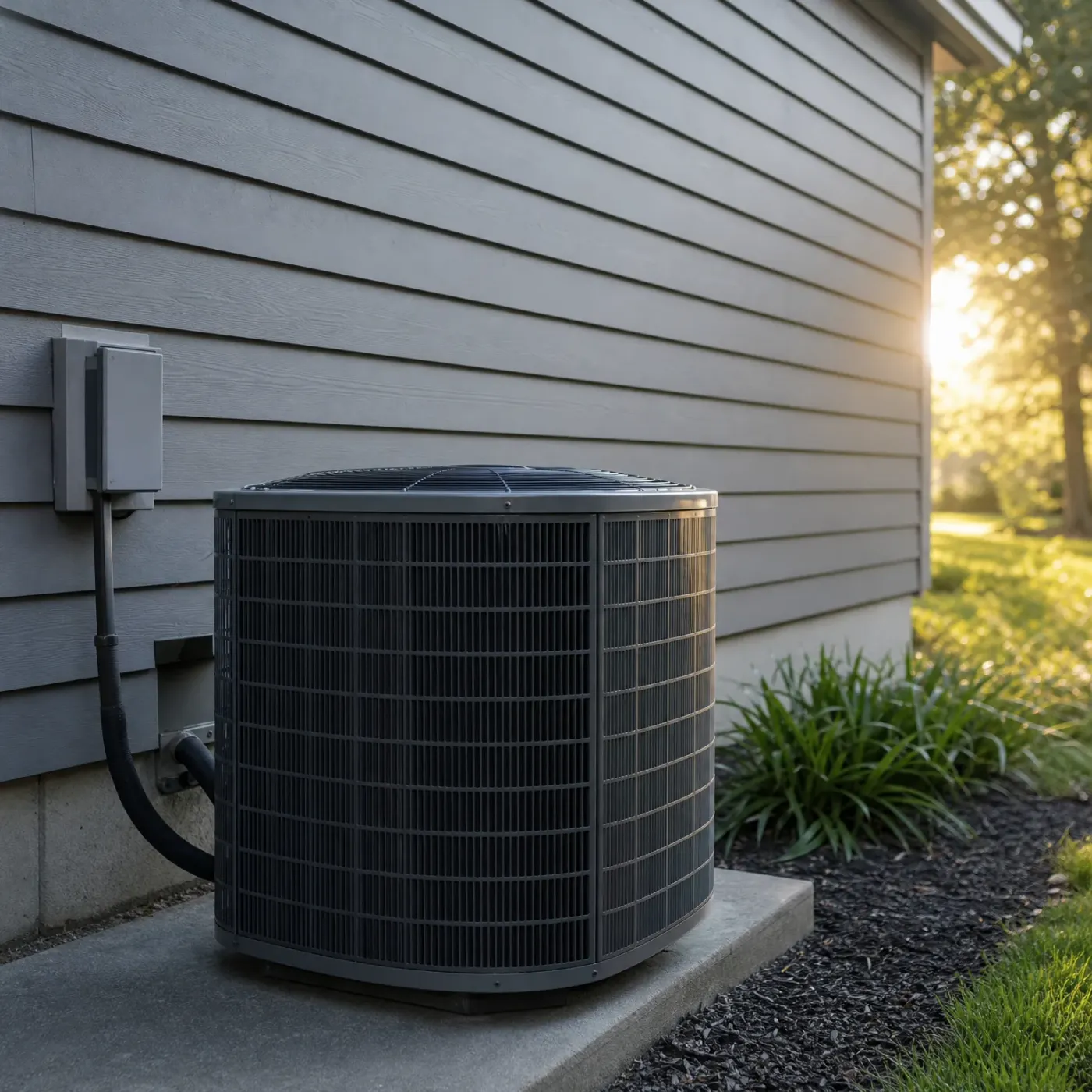
A gray outdoor heat pump unit on a concrete pad beside a house with horizontal lap siding, with a conduit running to a wall-mounted disconnect box and a green shrub to the left.

Fan Spinning Freely

This is what a working outdoor unit looks like: clean cabinet, clear airflow on all sides, nothing crowding it. The fan pulls air through the coil and pushes it out the top without strain. A unit kept clear like this puts less load on the motor and the capacitor that starts it.


An outdoor air conditioning condenser unit with dusty coils sits on a concrete pad against light horizontal siding, with an electrical disconnect box and refrigerant lines on the wall and a shrub and mulch at left.

Fan Stuck, Coil Caked

Grime like this across the coil makes the motor work harder to move the same air. Over time that extra strain wears down a capacitor or burns out a motor that might have lasted longer clean. If your outdoor unit looks like this and the fan won't turn, that buildup may be part of why.

Outdoor Fan or Indoor Blower

Outdoor Fan

  • If the fan is silent and the blades don't move at all, a failed capacitor is the most common reason, since it's what gives the motor its starting push.
  • A seized bearing can hold the blades still even when power is reaching the motor, and you may hear a hum as it tries to turn.
  • A contactor that's stuck open won't send power to the outdoor unit at all, so the fan, the compressor, and everything else out there stays dead.
  • Washington winters bring freezing rain and ice, and a blade that's iced over or jammed with debris can stop a motor that's otherwise fine.
  • If the fan was running fine and then just stopped mid-cycle, a motor that overheated and tripped its internal protector is a likely cause.

Indoor Blower

  • A blower that won't spin usually means no air moves through your ducts at all, even if the outdoor unit sounds normal.
  • A failed blower motor capacitor is common here too, and it fails the same way as the one outside, just on a different motor.
  • Since most homes in Washington heat with electricity through the heat pump, a dead blower in winter means no warm air anywhere in the house.
  • A control board that isn't sending the signal to start the blower will leave the motor untouched even though it's in good shape.
  • A blower wheel that's slipped loose on its shaft can keep the motor spinning while the fan blades themselves stay still.
A gray outdoor condenser unit on a concrete pad beside a house with horizontal lap siding, with a wall-mounted disconnect box, conduit and insulated refrigerant lines, a shrub at left and gravel at right.
The fan turns, the coil stays clear on all sides, and the unit pulls air through without strain.
An outdoor air conditioning condenser unit on a concrete pad beside a house with horizontal lap siding, with a green shrub to the left and a wide concrete slab in the foreground.
The fan sits still against the siding, no hum, no click, nothing moving when it should be running.
An outdoor condenser unit beside a horizontally sided house, encased in thick ice with hanging icicles, on a snow-dusted ground at sunset with bare trees in the background.

You go out for the mail before work and stop at the side yard. The sun's barely up, the grass still stiff with frost, and the outdoor unit is wearing a shell of ice an inch thick over the coil and the top grille. No hum. No click. Nothing. You crouch down and can just make out the fan blades through the ice, frozen in place like they've always been that way. The house is still warm, for now, electric heat pushing through the vents same as always. But standing there in the cold with your breath fogging, you know this one isn't waiting until the weekend.

Finding a pro stops being your job

Your request goes to one pro, not a list of companies.

No charge to send it. You decide if you hire them.

A gray outdoor air conditioner condenser unit on a concrete pad beside a house with horizontal siding and an electrical disconnect box, surrounded by grass.

Why the capacitor fails first

The capacitor gives the fan motor its starting push, and it does that job every time the unit cycles on. Over years of those cycles, the capacitor weakens before the motor itself ever wears out. That's why a dead fan so often turns out to be a cheap part behind a seized-looking one. A contractor can test it with a meter in minutes and know whether it's holding its charge or not.

A white outdoor heat pump unit on a concrete pad beside a house with horizontal lap siding, with a plain light wall and grass lawn to the left.

What the control board controls

The control board is what decides when the fan should run at all, separate from whether the motor or capacitor are fine. If the board isn't sending power to the fan circuit, the motor can be in perfect shape and still never turn. Washington homes running heat pumps through the winter put that board through a lot of on off cycles each day, and a bad relay on it looks the same from outside as a dead motor.

Power costs 13.17 cents per kilowatt-hour statewide

At 13.17 cents a kilowatt-hour, a heat pump that's stuck running the backup strips or cycling on and off trying to push air costs you more every day it sits broken. A fan that won't spin isn't just an airflow problem, it's a bill problem too.

EIA-861 2025 statewide residential average

A gray outdoor condenser unit sits on a concrete pad against a house wall with horizontal siding above a stone veneer base, with an electrical disconnect box and conduit on the wall and a leafy shrub in mulch to the left.

Clear and unobstructed

This unit sits open on its pad, nothing crowding the sides or the shrub a few feet off. Air pulls through the coil fins and out the top without resistance, which is what lets the fan motor start and run without strain.

An outdoor air conditioner condenser unit on a concrete pad beside a house with beige vinyl siding, with a gray electrical disconnect box and insulated refrigerant lines on the wall and river rock to the right.

Coil packed with debris

The fins on this one are caked with dirt and grass clippings, restricting the airflow the motor needs to work against. A coil this clogged makes the motor pull harder just to turn the blades, and that extra strain is often what burns it out.

A woman in a dark gray sweater reclines on a light sofa with eyes closed and a slight smile, under a textured gray blanket with an open book resting on her lap, with a lit table lamp and plant in the background.
A smiling bearded man in a navy crewneck sweater sits at a dinner table with a glass of red wine, plates and glasses in the foreground, in a dimly lit room with a lamp and framed picture behind him.

What to do about a still fan

  • A fan that won't turn almost always traces back to the capacitor, the motor, the contactor, or the control board.
  • A local contractor who services heat pumps all year knows which of those four fails most on the units common in your area.
  • Washington's mild summers mean your heat pump leans on that fan through the cold months too, keeping the house on electric heat.
  • Sending one request connects you with one licensed contractor near you, not a string of calls from companies you don't know.
  • The longer the fan sits still, the more the system relies on backup heat strips, and that shows up on your power bill.
  • Once you know which part is behind it, the fix is usually a straightforward call for someone who works on these units every day.

A heat pump fan that won't spin comes down to one of four things: the capacitor, the motor, the contactor, or the control board. Nothing about that changes whether it happens in July or January, but in Washington the stakes lean toward winter, since most homes here heat with electricity and that fan has to keep moving for the system to work as anything but a space heater. Sit broken long enough and the unit falls back on backup strips to keep the house warm, and those run up a bill that a working heat pump wouldn't.

You don't need to know which of the four it is before you ask for help. What matters is getting someone who already knows, because they've seen it on units like yours before. A contractor who services heat pumps through the cold months in this area has a good sense of which part tends to go first on the equipment people here actually run, and that's the kind of knowledge that shortens the whole visit.

Sending a request here puts you in touch with one licensed contractor local to you, not a handful of companies competing for the callback. That's one person showing up who already knows the make and model problems common to this area, not a stranger working from scratch. The fan not spinning is the symptom. Finding out which part stopped and getting it moving again is the part that's out of your hands once you send the request.

An outdoor air conditioner condenser unit on a concrete pad beside a gray horizontal-lap-sided house, with an electrical disconnect box and refrigerant line on the wall, grass, shrubs and a tree with low sun behind.

Let someone else find the pro

Send it today

The pro who reaches out is licensed in Washington.

There's no charge for the request.