

A moss-covered wooden fence in the foreground of a grassy lawn, with a row of dark wood-clad houses with porches to the right and tall conifers under an overcast sky.

Furnace Repair in Vancouver, WA

Tell us about the job

Takes about a minute. No obligation.

RepairFurnace or heatingClark County, WA
Step 1 of 2

What ZIP code is the job in?

Furnaces in Clark County run from October through June, close to nine months of the year. Overnight lows average 35°F in December and January. That's cold enough for a furnace to run most of the night, but it's not extreme, and it doesn't wear parts out faster than normal. There's nothing about the climate here that points to an unusual cause when a furnace stops working right. A failed igniter, a dirty flame sensor, a clogged filter, a blower motor on its way out. These are still the likely answers. Two different problems can show up as the same symptom, so getting the actual cause right matters more than guessing at it.

9 months
October through June, your furnace is on duty
35°F
the average winter night it heats against
6 winter storms
in ten years, the nights a failure hurts most
Isometric line illustration of a cutaway house showing interior rooms with furniture and a furnace with ducting and a flue pipe extending through the roof.
Your furnace works hardest from November through April.

NOAA nClimDiv, 1991–2020 normals

Furnaces in Clark County start their nine-month run in October.

September is when a weak igniter or a tired blower motor is still working. Give it a load it hasn't carried since spring, and that's when it quits.

Electricity in Washington ran $34.87 per million Btu in 2024. That's cheap compared to most of the country, and it's part of why a lot of furnaces here are electric-forced-air or heat pumps rather than gas. Either way, the repair logic doesn't change. A gas furnace with a bad igniter still needs a new igniter. An electric furnace with a failed sequencer or a burned-out heating element needs that part replaced. The cost of power doesn't make the parts fail differently, it just shows up on the utility bill while the furnace is down. Fixing what's actually broken is still the only thing that gets the heat back on.

Half the homes here were built in 1993 or later

Half the homes in Clark County were built in 1993 or later. That means a lot of furnaces here were installed in a house young enough that the system itself is probably still within its working life. If your furnace came with a newer build, repair is usually the right call before replacement even enters the conversation.

Find a contractor
A man in a cap, gray jacket and tan cargo pants, seen from behind, carries a worn canvas duffel bag up steps toward a dark navy front door, with a potted shrub beside the entry.
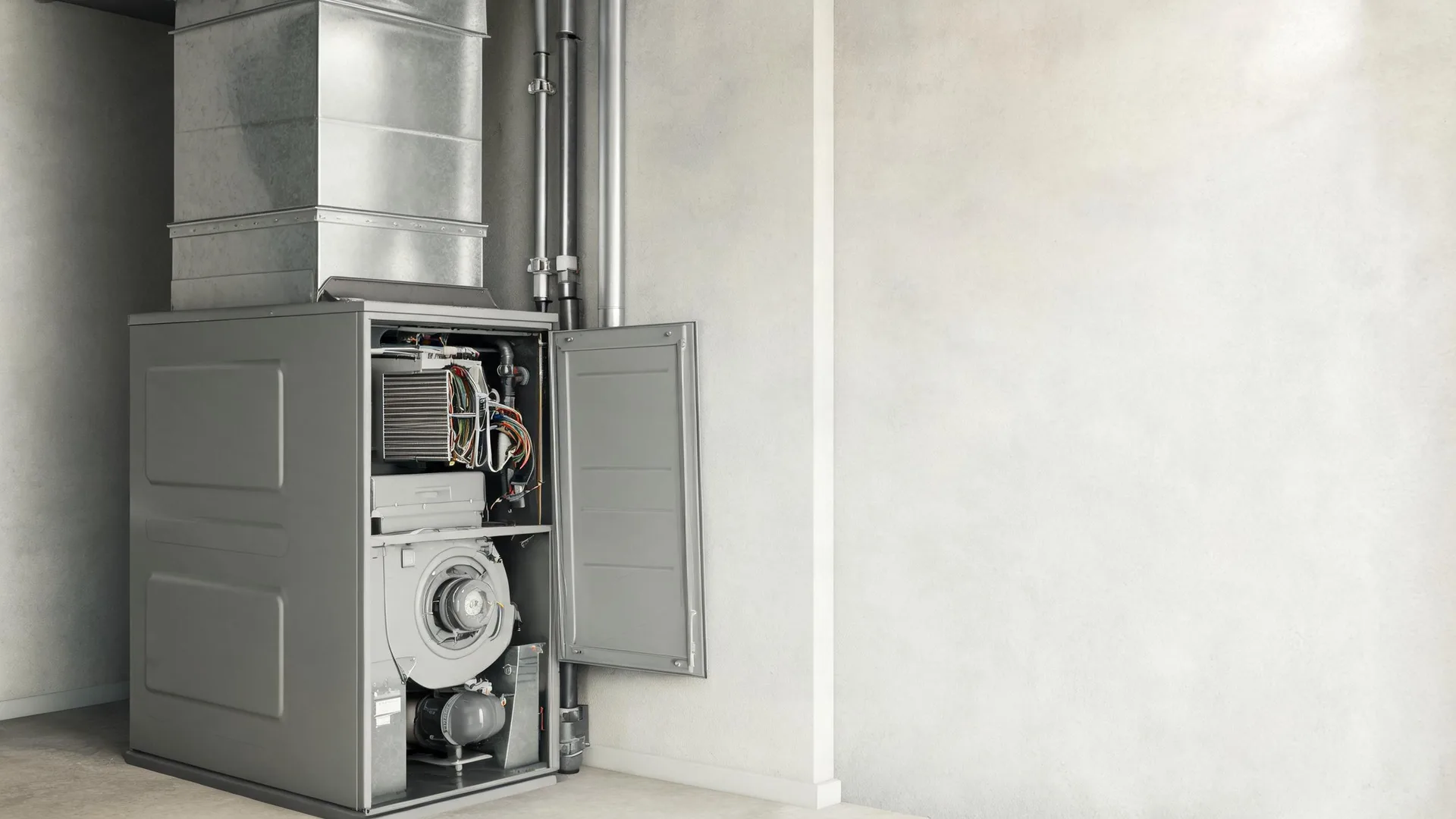
A gray residential gas furnace installed in an unfinished basement, surrounded by ductwork, a metal flue pipe, and a gas supply line.

What you can check before anyone comes out

Before anyone comes out, check the thermostat batteries and make sure it's set to heat, not just on. Then go look at the filter. Pull it out and hold it up to a light. If you can't see light through it, that's enough to choke off airflow and shut the furnace down on purpose, that's not a malfunction, it's the system protecting itself. Next check the breaker panel. A furnace that won't start at all, no sound, no blower, nothing, is sometimes just a tripped breaker. Flip it off and back on. If you have a gas furnace, check that the gas valve on the line going into it is turned to open. If the furnace starts but won't stay lit, or it's blowing cold air, those point to something past what you can check yourself, an igniter, a flame sensor, a control board. Don't take the cabinet apart to look. And if you smell gas, don't troubleshoot at all. Get out and call it in.

A small problem can turn into a bigger one overnight

A furnace that's short cycling, making a new noise, or tripping its limit switch is telling you something's already wrong. Keep running it and a cracked heat exchanger can spread, a struggling blower motor can burn out its windings, a dirty flame sensor can start a pattern of shutdowns that stresses the igniter too. The part that's failing is rarely the only part that pays for it.
Some problems just mean a cold house, others mean real risk

A clogged filter starving the system for air is worth fixing soon, but it won't hurt anyone if it waits a day. A cracked heat exchanger, a gas smell, or soot around the cabinet is different. Those put combustion byproducts somewhere they don't belong. Knowing which kind of problem you have is what tells you whether to shut it off and call now or just get it looked at this week.

Most furnace calls start with one of a few things the homeowner already noticed. The heat kicks on, runs for a short while, then shuts off and starts again later. That's short cycling, and it usually traces back to a flame sensor that can't see the flame anymore, or a limit switch tripping because airflow is restricted somewhere. A furnace that blows air but the air isn't warm points somewhere else, often an igniter failing to light the burners at all, or a gas valve that isn't opening. Rattling, squealing or a new knock when the blower starts is almost always the motor or its bearings telling you they're close to done. And if the burners light but flicker yellow instead of burning steady blue, that's worth a call regardless of whether the furnace is keeping up with the house. None of these mean the same repair. They mean it's time to get the actual cause in front of someone who can test it.

A repair makes sense when the part that failed is one part and the rest of the furnace has no reason to be weak. An igniter, a flame sensor, a draft inducer, these fail on their own timeline, and swapping one doesn't leave the rest of the system any older than it was. Replacement starts to make more sense when the same furnace keeps needing a call, season after season, or when what's being quoted is work on the heat exchanger or the control board, the parts that sit at the center of everything else working. A furnace that needs repair after repair after repair is telling you something the next repair won't fix. It's not that the furnace is old. It's that it's stopped failing in one place at a time.