Three illuminated Craftsman-style houses with stone and wood-shingle facades line a wet residential street at night, surrounded by trees and landscaped gardens.

Heat Pump Repair in Bellingham, WA

Tell us about the job

Takes about a minute. No obligation.

RepairHeat PumpWhatcom County, WA
Step 1 of 2

What ZIP code is the job in?

What keeps failing tells you more than age

A heat pump that trips the same breaker every few weeks, or needs a new capacitor every season, has a compressor or a control board wearing out underneath. A refrigerant leak that gets sealed and stays sealed is a different situation than one that keeps showing up at the same fitting. A system with a string of small, unrelated repairs behind it is in worse shape than its age alone would suggest.


Why some failures point toward one answer

A failed compressor or a cracked heat exchanger usually means replacement, because neither part gets swapped on its own at a cost that makes sense against a new unit. A bad capacitor, a failed contactor, or a single leak that gets found and fixed are the kind of repairs a healthy system takes in stride. The real question a contractor is answering isn't just what broke, it's whether everything else in the system still has good years left in it.

27°F
the average winter night it heats against
68°F
the average summer afternoon it cools against
Isometric cutaway illustration of a single-story house showing interior rooms with furniture, an attic duct system connected to an indoor air handler, and an outdoor condenser unit linked by lines along the exterior wall.

Winter nights in Whatcom County average 27°F.

A heat pump here isn't fighting single-digit cold, so it wears slower and a repair usually makes sense.

Whatcom County gets hard storms. If the outdoor unit took hail or debris, get it looked at even if it's still running.

23% of homes statewide lost power a day or more in 2024
Winter nights average 27°F
Power costs 11.9 cents a kWh statewide
Nothing about this place is hard on a heat pumpElectricity here runs 11.90 cents per kilowatt-hour, close to the national average, so a repair doesn't fight high running costs on top of the fix itself.

That 27°F average matters when you're deciding whether to fix what you have. A compressor that's spent its life cycling against mild nights has less wear on it than one working the same years in a colder state. So if a contractor tells you the fix is a new capacitor or a contactor, that's usually the whole story, not the first of many calls. Worth getting it looked at rather than planning around a replacement.

It's usually worth repairing

It has an easier job here than in most places, so your heat pump is often in decent shape. Repair is usually worth it.

Find a contractor
A man in a gray t-shirt and tan work pants, seen from behind, climbs concrete steps toward a dark blue front door while carrying a canvas tool bag, with a potted shrub beside the entry.
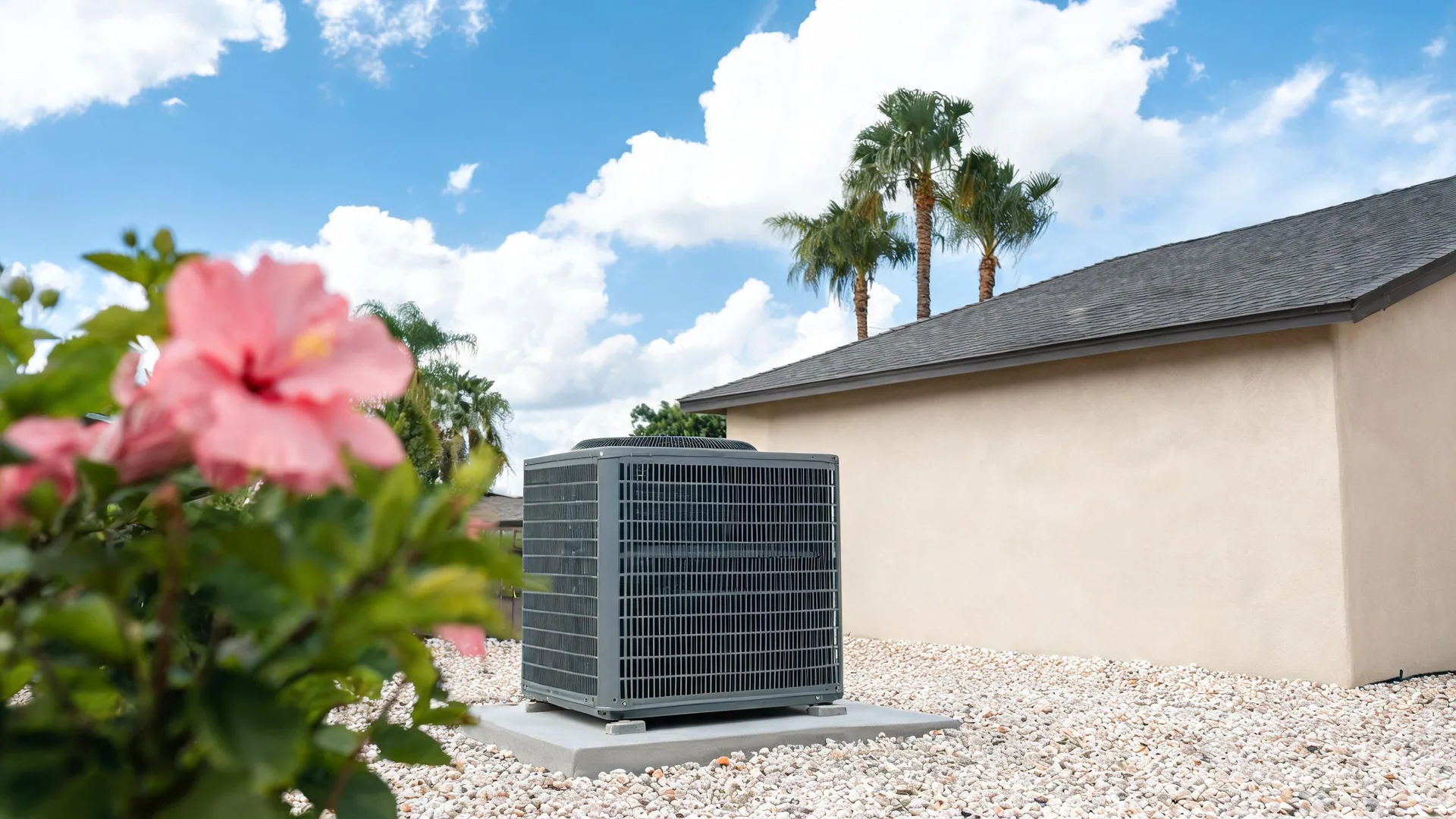
A gray heat pump condenser unit mounted on a concrete pad against the gray lap-siding exterior wall of a house.

What to check before you call anyone

Before anyone comes out, there are a few things worth checking. Look at the thermostat first. Make sure it's set to heat and the setpoint is actually above room temperature, and check the batteries if it uses them. Go to the breaker panel and see if the breaker for the outdoor unit or the air handler has tripped. If it has, reset it once. If it trips again, stop and leave it off. Walk outside and look at the outdoor unit. Clear away leaves, ice or anything blocking the sides and top, since it needs open airflow to move heat at all. If the coil is caked in ice beyond a thin frost layer, that's worth noting for the tech rather than trying to chip off yourself. Check your air filter. A filter clogged with dust chokes airflow and can make a system seem like it's failing when it's just starved for air. Last, listen for anything unusual, a hum with no fan movement, a clicking that repeats without the system starting, or a buzzing from the outdoor unit. None of that tells you what's wrong, but it's useful to describe when you call.

A short in the compressor windings gets worse under power

If a compressor has a developing short, running it keeps heating the windings that are already breaking down. What might have been caught as a weak compressor turns into a dead one. Short cycling does the same kind of damage faster, since each start pulls a hard surge of current through wiring that's already struggling.

Ice on the coil shuts off airflow entirely

A heat pump that's low on refrigerant or has a failing defrost control will frost over, and once ice builds past a thin layer it blocks the airflow the system needs to move heat at all. Running it in that state doesn't just fail to heat the house, it forces the compressor to work against a coil that can't do its job, which is how one bad sensor turns into a bad compressor too.

Most heat pump failures start small and in the same handful of places. The capacitor that kicks the compressor and fan motor into motion weakens with age and years of heat cycling, and when it goes, the unit hums or clicks but won't start. The contactor, the switch that sends power to the outdoor unit, pits and burns from years of arcing every time it closes, until it sticks or stops making contact at all. Refrigerant doesn't get used up, so if a system is low, it's leaking somewhere, usually at a fitting or a coil joint, and that leak won't fix itself. The reversing valve, the part that switches the system between heat and cooling, can stick from corrosion or a bad coil and leave you stuck in one mode. Compressors themselves rarely fail out of nowhere. They wear down after years of running on a weak capacitor, a refrigerant charge that's off, or airflow that's been restricted for a long time, so by the time a compressor actually dies, it's often the last part to go, not the first.

A diagnostic visit starts before any panel comes off. A tech will ask what the system is doing, when it started, and whether it happens in heat mode, cooling mode, or both, since the answer narrows down what to check first. Then comes the thermostat and the breaker, the same things worth checking yourself, because there's no point chasing a bad compressor if the real problem is a tripped breaker. From there it's gauges on the refrigerant lines, a meter on the capacitor and contactor, and a look at the coil and airflow. Each reading either clears a part or points at it. The goal isn't to replace things until the problem goes away, it's to find the one part that's actually failing and leave the rest alone.