







A single-story wood-shingled house with a moss-covered roof, surrounded by shrubs, ferns and tall conifers, with a mown lawn in the foreground.

Heat Pump Repair in Cathlamet, WA

Tell us about the job

Takes about a minute. No obligation.

RepairHeat PumpWahkiakum County, WA
Step 1 of 2

What ZIP code is the job in?

Heat pumps here run almost ten months out of the year, September through June. August is the one month it sits idle before that stretch starts. A part that was already wearing out, a weak capacitor, a low charge, a contactor going bad, tends to show itself in the first cold snap of the season, right when the system starts working hard again after sitting quiet. If your heat pump is acting up now, early in the run, that's not a coincidence. It's worth having someone look at it rather than waiting to see if it sorts itself out, because the load only gets steadier from here.

10 months
September through June, your system heats
35°F
the average winter night it heats against
71°F
the average summer afternoon it cools against
Isometric illustration of a cutaway single-story house showing interior ductwork and an air handler connected by lines to an outdoor condenser unit on a pad beside the building.

A heat pump that won't switch out of defrost, or never starts it, needs a tech regardless of what the thermostat shows.

Flip the switch at the outdoor disconnect off and back on once. If the system still won't run, that reset wasn't the problem.

Nothing here beats up a heat pump, so when one fails, it's the part, not the place

4 damaging wind events from 2015 to 2024
1 hail event from 2015 to 2024
Winter nights average 35°F
Your home isn't the problemHalf the homes here were built in 1978 or earlier, and a heat pump doesn't know the difference

A diagnostic visit starts outside, at the unit itself. A tech checks the capacitor's output against what it's rated for, tests the contactor for pitting, and watches whether the fan starts clean or struggles. From there it's gauges on the refrigerant lines, since a low charge shows up as a pressure reading that doesn't match what the system needs to run right. If the complaint is weak heat or a defrost cycle that won't end, the reversing valve and defrost control get checked next, because one tells the system which way to run and the other tells it when. Electrical readings at the board rule out a failing sensor before anything gets swapped. The goal is to find the one part that's actually failed rather than guessing, since a heat pump that's heating poorly can trace back to any of these, and only one diagnosis points to the right fix.

Get it looked at early

Problems tend to show up in the first weeks of the season, when the load hits a part that was already weak.

Find a contractor
A man in a dark cap, navy T-shirt and tan work pants, seen from behind, carries a canvas tool bag up porch steps toward a dark blue front door, with a potted shrub in a blue planter to the right.
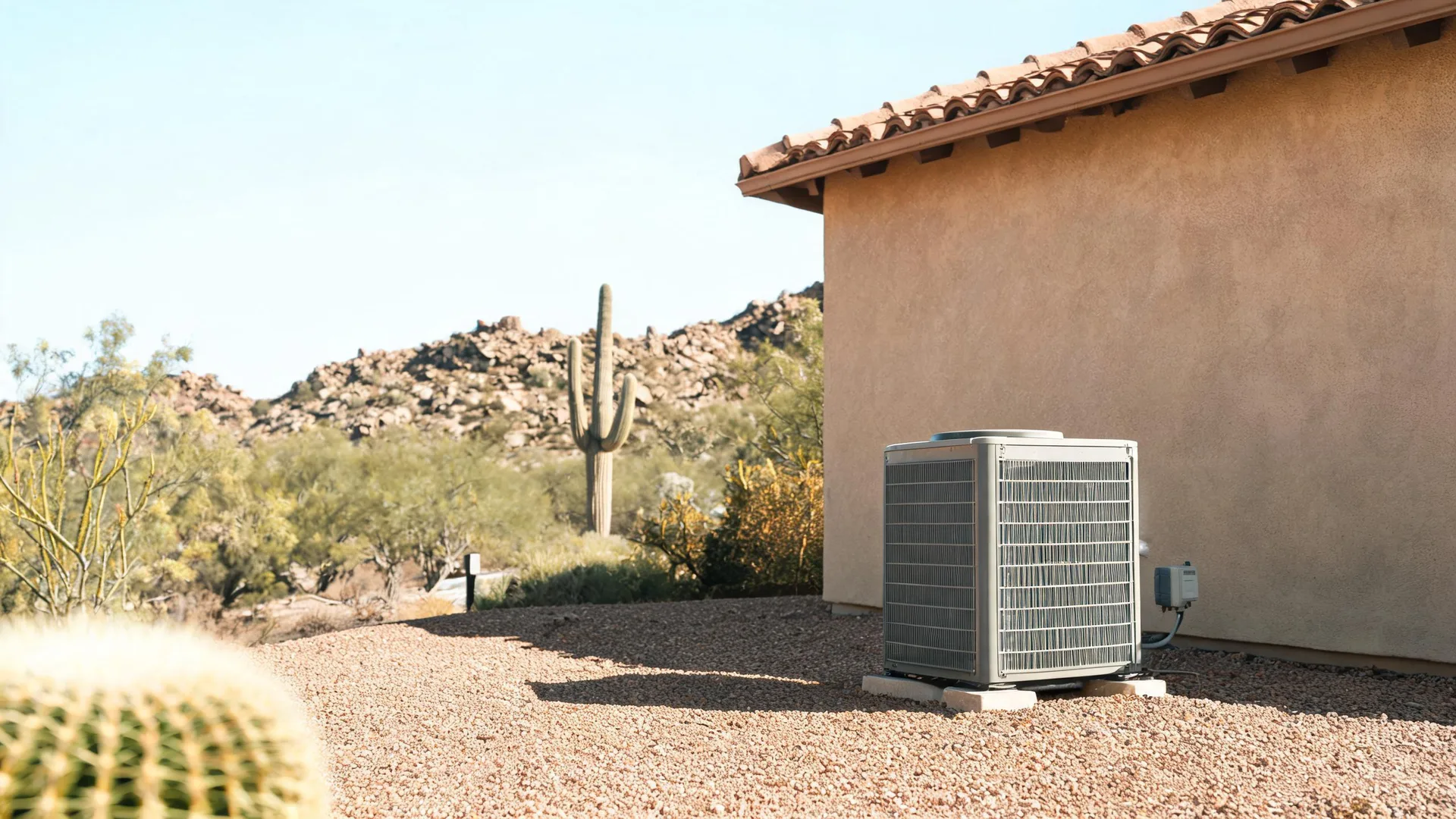
A gray outdoor HVAC unit mounted on a concrete pad beside a house with gray lap siding and a stone foundation.

What actually wears out in a heat pump

A heat pump runs both sides of the job, heating and cooling, so its parts wear from both directions instead of one. The reversing valve is the part most specific to it, and when it sticks, the system blows the wrong temperature air or gets stuck in defrost. Run capacitors give the compressor and fans their starting push, and that part weakens slowly, so the first sign is usually a slow start or a hard clunk rather than a sudden no-run. Contactors pit and burn from constant cycling until they stop pulling in reliably. A low refrigerant charge, usually from a slow leak at a fitting or coil, shows up as weak heating or ice building on the outdoor coil. The outdoor coil itself collects dirt and debris over time, and a dirty coil makes the whole system work harder to move the same heat. None of this is about one bad stretch of weather. It's wear that adds up from steady running, and it tends to surface right when the system is asked to work hardest.

A small problem keeps feeding on itself

A compressor starting against a weak capacitor draws more current than it should every time it kicks on, and that extra strain wears the windings a little more with each cycle. A contactor with pitted contacts arcs worse each time it closes until it stops pulling in at all. None of this holds steady while you wait. It moves in one direction, and running the system keeps pushing it there.
The compressor is the part that pays for the delay

Most failures in a heat pump, a weak capacitor, a bad contactor, a failing sensor, are a straightforward swap on their own. The compressor is not, and it's also the part most likely to get damaged when something upstream goes unchecked, whether that's a low charge, a stuck reversing valve, or a coil caked with dirt making it work harder to move the same heat. Catching the small failure early is what keeps the compressor out of it.

Most heat pump problems announce themselves before the system quits outright. Air coming out lukewarm instead of warm, or the system running long stretches without the house catching up to the thermostat, usually points to a weak capacitor, a low charge, or a coil that needs cleaning. Ice building up on the outdoor unit and not clearing during defrost cycles is another one worth acting on, since it means the defrost control or the reversing valve isn't doing its job. A clicking or humming sound at the outdoor unit, where the fan doesn't start or starts slow, is a capacitor giving out. Short cycling, where the system shuts off and restarts within a few minutes instead of running a full cycle, puts extra wear on the compressor every time it happens. Any of these is worth having looked at rather than waiting to see if the system starts running normally again on its own.

A compressor is the most expensive part in a heat pump, and it's also the reason repair makes sense more often than not. Everything else, the capacitor, the contactor, the reversing valve, the defrost board, can be swapped on its own without touching the compressor at all. Replacement only starts to make sense when the compressor itself is the thing that failed, since that's the part that's expensive enough and central enough to change the math. A tech can usually tell which situation it is just by diagnosing what actually failed. If the compressor's still good, there's a repair that fixes the system without replacing it.