Illuminated craftsman-style houses on a rain-slicked residential street at night, backed by tall evergreen trees.

Heat Pump Repair in Aberdeen, WA

Tell us about the job

Takes about a minute. No obligation.

RepairHeat PumpGrays Harbor County, WA
Step 1 of 2

What ZIP code is the job in?

Winters here don't push a heat pump hard

Overnight lows around Aberdeen average 34°F through December, January and February. A heat pump in that range isn't straining to pull heat from outside air the way one does in places that drop well below freezing.

So a breakdown is usually fixable

When the outdoor unit hasn't been working against hard cold all winter, a problem is more likely a worn part or something overdue for service than a system worked past its limit. That makes repair worth looking into before assuming the worst.

10 months
September through June, your system heats
34°F
the average winter night it heats against
71°F
the average summer afternoon it cools against
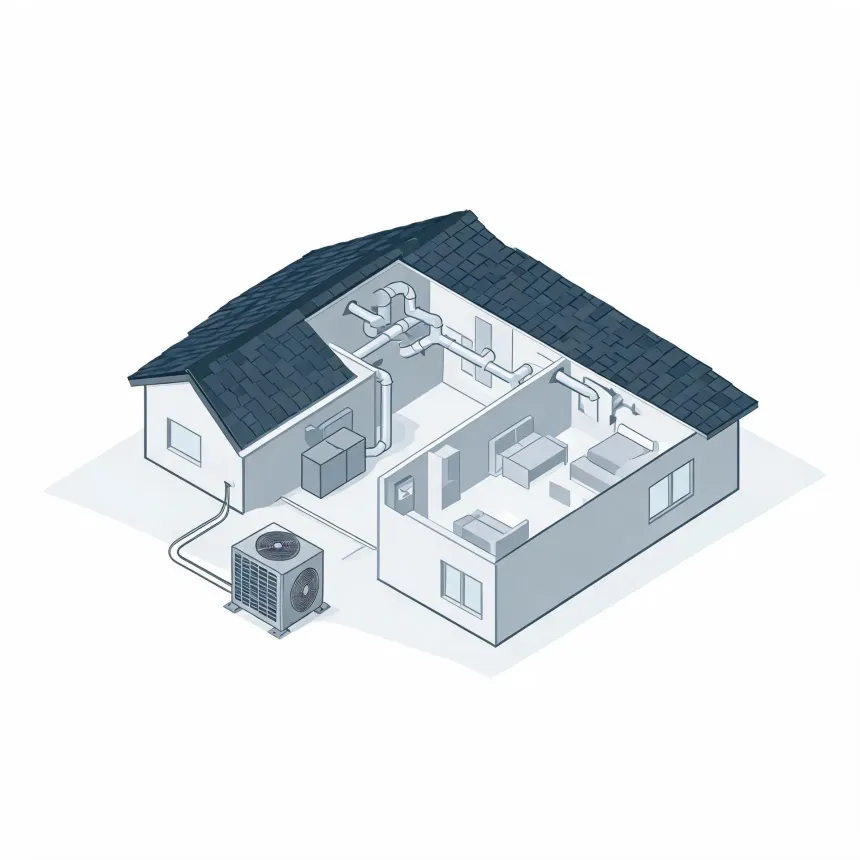
Isometric cutaway illustration of a single-story house showing interior rooms, ceiling ductwork, an indoor air handler, and an outdoor condenser unit connected by lines on the ground.

A technician starts outside at the unit, not with a parts list already in mind.

What the gauges and readings show decides whether this is a quick fix or a bigger repair.

Heat runs here most of the year, so a weak part gets found fast

Heat runs September through June
Winter nights average 34°F
Power costs 11.9 cents a kWh statewide
A house like any otherHalf the homes around Aberdeen were built in 1974 or earlier, half later. Either way, a heat pump problem comes down to the same checks.

That's the case for having a repair looked at rather than putting it off. A part that's worn or a refrigerant charge that's low won't fix itself, and the mild load here means it's usually just that, not a system beyond saving. Waiting tends to turn a small fix into a bigger one, since a heat pump low on charge or running on a bad part works harder than it should every time it cycles on. Get it checked before it has to work through a cold snap short on whatever it's missing.

It's usually worth repairing

It has an easier job here than in most places, so your heat pump is often in decent shape. Repair is usually worth it.

Find a contractor
A gray air-source heat pump mounted on a concrete pad next to a house with gray vinyl siding, surrounded by gravel and flanked by green shrubs and white hydrangea flowers.

The signs show up before the failure does

A heat pump that's struggling doesn't usually just quit. It tells you first. Short cycling is one of the clearest signs. The system kicks on, runs a few minutes, shuts off, then starts again before the house ever feels it. That can be a sensor out of place, a refrigerant charge running low, or airflow choked down somewhere in the ducts. Warm air that isn't warm enough is another sign. In heating mode the air from the vents should feel distinctly warm, not just less cold than the room. If it feels lukewarm, the reversing valve or the compressor itself may not be doing its full job. Ice on the outdoor unit is worth a look too, past a light morning frost that burns off on its own. These units defrost themselves on a cycle, and when that cycle stops working, ice builds up and blocks the coil from doing anything useful. A unit that runs constantly without the house ever reaching the set temperature is working against something, whether that's a duct problem, a failing part, or a charge issue. None of these mean the system is done. They mean something specific inside it needs attention.

A low charge makes the compressor work harder

When refrigerant is low, the compressor has to run longer to move the same amount of heat. That extra strain shortens its life, and a compressor is the one part in a heat pump worth protecting. Left alone, a small leak stays a small repair. Run on top of it for a season and the compressor itself can be the thing failing next.

Ice that doesn't melt keeps adding to itself

A normal defrost cycle clears frost in minutes. When the defrost control or a sensor behind it fails, ice stays on the coil and thickens every time the unit runs. Thicker ice blocks more airflow, so the system works harder to move less heat, which only pulls more moisture out of the air to freeze. Caught early it's a control board or sensor. Left running, the coil itself can take the damage.

Before anyone comes out, a few things are safe to check yourself. Look at the thermostat first. Make sure it's set to heat and the set point is actually above room temperature, since a setting bumped by accident looks exactly like a breakdown. Check the air filter. A filter clogged with dust chokes airflow across the indoor coil, and that alone can cause weak heat or ice buildup outside. Walk around the outdoor unit and clear away leaves, mulch or anything stacked against it, since it needs open air on all sides to work at all. Check the breaker if the system won't start at all. None of this fixes a bad compressor or a low charge, but it rules out the simple stuff before you pay someone to find it.

A repair is worth doing if the system can still hold its charge and move air the way it's supposed to once the broken part is fixed. A failed capacitor, a bad sensor, a stuck reversing valve, these are normal wear items, and replacing one brings the unit back to full working order. What changes the math is the compressor. It's sealed, it's the most expensive part to replace, and when it fails, a lot of contractors will tell you straight that putting a new compressor in an old system isn't worth it. Age matters less on its own than what's actually broken. An older unit with a bad capacitor is a repair. An older unit with a failed compressor is a conversation about replacing the whole system. Ask what part is actually causing the problem before deciding which conversation you're having.