A lit craftsman house with glowing windows on a rainy night, surrounded by tall evergreen trees and a wet reflective street.

Heat Pump Repair in Friday Harbor, WA

Tell us about the job

Takes about a minute. No obligation.

RepairHeat PumpSan Juan County, WA
Step 1 of 2

What ZIP code is the job in?

Winters here don't push a heat pump hard

Overnight lows in December, January and February average 36°F in San Juan County. A heat pump here isn't fighting single digit nights the way one does further inland, so the compressor and coils see a lighter load over the life of the system.

A breakdown is more likely wear than damage

Winter storms have hit San Juan County only 5 times in the last ten years. Against that, most heat pump trouble here traces back to a part reaching the end of its life rather than storm damage, which is worth knowing before assuming the worst.

10 months
September through June, your system heats
36°F
the average winter night it heats against
71°F
the average summer afternoon it cools against
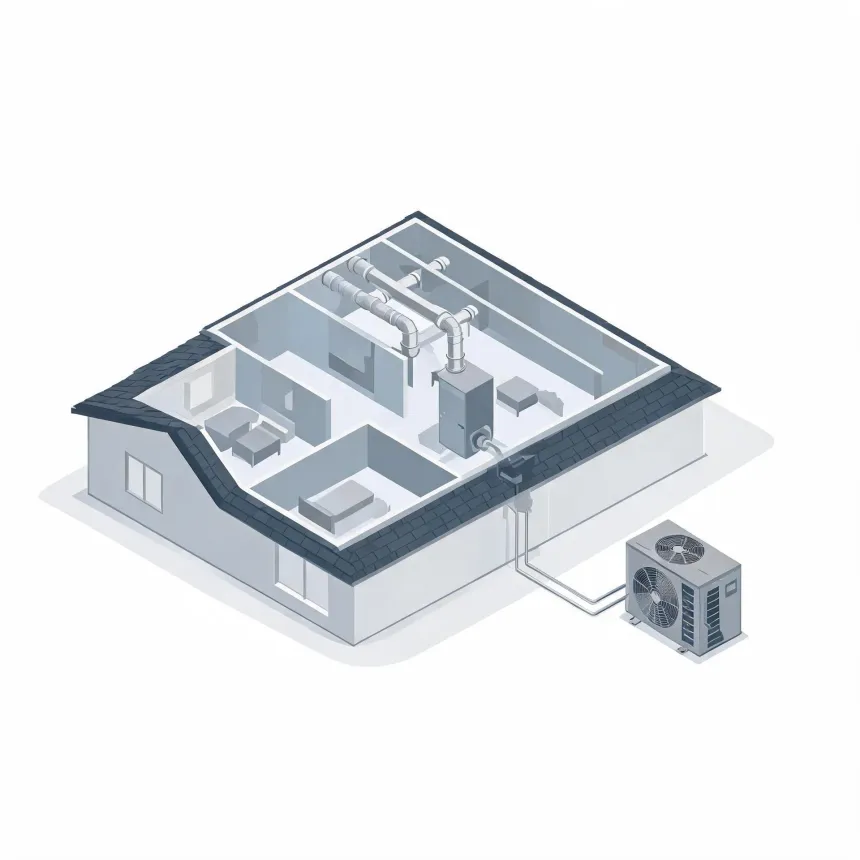
Isometric cutaway illustration of a single-story house showing interior rooms with ductwork, a furnace or air handler, and refrigerant lines running outside to a condenser unit on a pad.

Half the homes in San Juan County were built in 1988 or later.

A heat pump that came with a newer house still has working life ahead of it, which is why repair usually makes more sense than replacement.

Ten months of work a year, starting in September

Heat runs September through June
49 damaging wind events from 2015 to 2024
5 winter storms from 2015 to 2024

Damaging wind has hit San Juan County 49 times between 2015 and 2024, which sounds like a lot for a small county. Most of that wind passes through without touching a heat pump at all, and when it does, it's more likely to knock debris into the outdoor unit or loosen a connection than to cause real damage. That's not the usual story here though. A heat pump acting up in this county more often comes down to a capacitor, a contactor, or a coil near the end of its run than anything the weather did. Worth asking the tech what they actually found before assuming a storm is to blame.

Get the heat pump looked at, not replaced

A heat pump that came with a newer house still has the years to back up a repair. Get a tech out to find the part that's failing and fix that part.

Find a contractor
A gray air-source heat pump mounted on a concrete pad next to a house with gray vinyl siding, surrounded by gravel and flanked by green shrubs and white hydrangea flowers.

A diagnostic finds the one part behind the problem

A diagnostic starts outside at the unit, not with a guess. A tech checks the readings first, the pressures, the temperature split between the air going in and the air coming out, the amp draw on the compressor and the fan motor. Those numbers point to a system either moving heat the way it should or struggling somewhere specific. From there it's a process of elimination. A capacitor gets tested under load, not just looked at. A contactor gets checked for pitting where the contacts have been arcing. The reversing valve gets listened to and felt, since a stuck valve often hums or stays warm on the wrong side. If the coil's iced over, the tech traces that back to the defrost board and sensor before touching the ice itself, because clearing it doesn't fix whatever stopped the defrost cycle from running. A refrigerant leak takes longer to find than to fix. That means dye or an electronic sniffer at every fitting and joint, since the leak is almost never where the symptom shows up. By the end, the tech should be able to point to the one part causing the trouble and say plainly whether it's worth fixing on its own or whether it's a sign the system's winding down as a whole.

Check the thermostat settings first

Make sure it's set to heat and the setpoint is actually above room temperature. A schedule change or a bumped switch can look exactly like a broken system when nothing mechanical is wrong at all.

Look at the outdoor unit

Walk outside and check that nothing is blocking the unit. Leaves, a fallen branch, or anything pressed against the coil or fan cage can keep it from moving air the way it needs to.

A heat pump that's struggling still moves heat, just poorly, so it's tempting to let it run until someone has time to deal with it. That's usually the wrong call. A weak capacitor makes the outdoor fan motor spin without the push it needs to start clean, so the motor windings take the strain instead, and a small part left alone drags a bigger one down with it. A refrigerant leak behaves the same way. Low charge makes the compressor run longer and hotter to hit the same setpoint, and that kind of damage doesn't reverse once it's done. Ice on the outdoor coil from a stuck defrost cycle cuts off airflow entirely, and running the system through that only adds load with nowhere for the heat to go. The part causing the symptom is almost never the only part paying for it.

A tech can repair almost anything on a heat pump. The real question is whether it's worth doing. A single failed part, a capacitor, a contactor, a fan motor, is almost always worth replacing on its own, since the rest of the system keeps running fine once that one piece is swapped. The compressor is the exception. It costs more than the rest of the system combined to replace, and if it's failing, that's usually old age catching up with the whole unit at once, not one bad part. A refrigerant leak sits in between. A single leak at a fitting is a fair repair. A system that's needed recharging more than once has a leak somewhere in the coil itself, and that tends to come back no matter how many times it's patched.