







A rain-slicked suburban street at night lined with illuminated craftsman bungalows and tall evergreen trees.

Heat Pump Repair in Goldendale, WA

Tell us about the job

Takes about a minute. No obligation.

RepairHeat PumpKlickitat County, WA
Step 1 of 2

What ZIP code is the job in?

Half the homes in Klickitat County were built in 1986 or later. If yours is one of them, your heat pump likely isn't that old either, even if it's not the original unit. A heat pump with a lot of working life left is usually worth repairing rather than replacing. Before you assume the worst, it's worth finding out if the problem is something straightforward, like a failed capacitor or a low charge, rather than the system giving out.

10 months
September through June, your system heats
2 months
July through August, it cools
27°F
the average winter night it heats against
80°F
the average summer afternoon it cools against
Isometric line illustration of a cutaway single-story building showing interior rooms, ceiling ductwork, an indoor air handler, and an outdoor condenser unit connected by refrigerant lines.
Your system heats September through June and cools July through August.

NOAA nClimDiv, 1991–2020 normals

Goldendale winters average 27°F at night, not deep cold.

A heat pump here isn't fighting extreme temperatures to keep up, so a repair is more likely to hold.

Winter storms here are common, but they're not what takes down a heat pump

100 severe weather events from 2015 to 2024
23% of homes statewide lost power a day or more in 2024
38 damaging wind events from 2015 to 2024
Heat pumps here work ten months of the yearHeat starts in September, so August is when a weak part finally gets found

Most heat pump failures trace back to a handful of parts. The capacitor is a common one. It gives the compressor and fan motors the jolt they need to start, and it weakens over time until the system hums but won't kick on. A low refrigerant charge is another, usually from a slow leak rather than the system using it up. The reversing valve is worth knowing about too, since it's what lets the unit switch between heating and cooling, and when it sticks you'll get warm air when you expect cold or the reverse. Outdoor coils get blamed for a lot of problems that are really airflow problems, dirt and debris blocking the coil so it can't move heat the way it should. None of these mean the system is done. They're parts, and parts get replaced.

Get the part fixed, not the system replaced

Most of these homes are newer, so the heat pump behind that warm air or that hum is likely newer too. A failed capacitor or a stuck reversing valve is a repair, not a reason to start over. Get someone out to look at it before you plan on anything bigger.

Find a contractor
A man in a cap, gray long-sleeved shirt and brown work pants walks up concrete steps toward a dark blue front door, carrying a worn canvas tool bag beside a potted shrub.
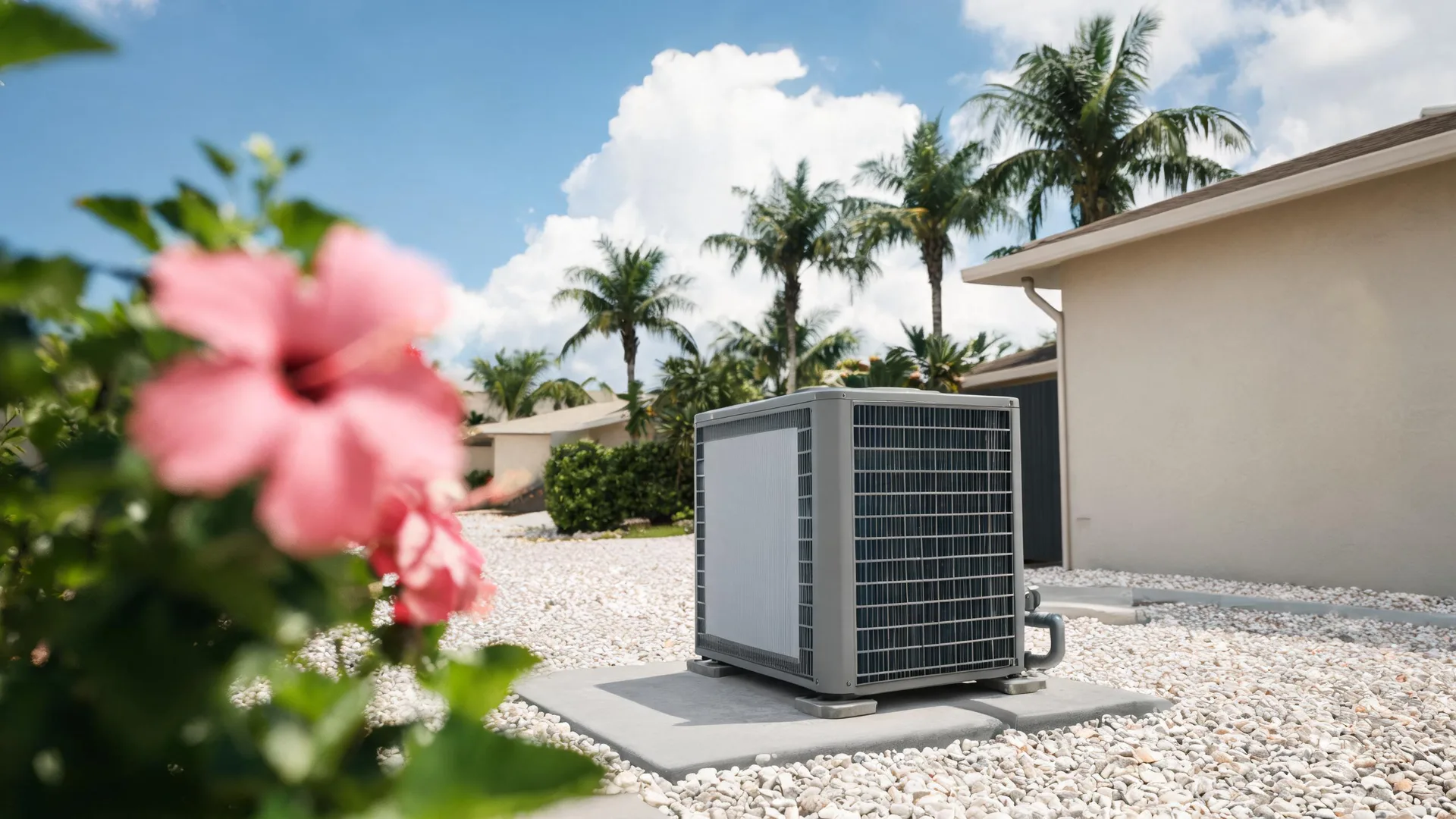
A gray heat pump outdoor unit mounted on a concrete pad next to the stone-accented exterior wall of a house.

What to check before you call

Before anyone comes out, check the thermostat is set to heat and the setpoint is actually above room temperature. Look at the outdoor unit. If the coil is caked with leaves, ice or debris, the system can't move heat the way it needs to, and clearing it off by hand is safe to do. Check the air filter. A filter clogged with dust chokes airflow and can make a working unit act like a failing one. Walk the vents inside and make sure none are closed or blocked by furniture. If you've got a breaker panel, check nothing's tripped, since a heat pump that won't start at all sometimes just lost power. What you shouldn't touch is the refrigerant lines or anything inside the outdoor cabinet. That's sealed, pressurized equipment, and opening it up does more harm than good.

The sounds tell you where to look

A hum with no air moving points to the capacitor or the compressor itself. Clicking that repeats without the system starting usually means the control board is sending power but something downstream isn't responding. Grinding or squealing from the outdoor unit points to a fan motor bearing wearing out. Each sound narrows down the part, so it's worth noting what you're hearing before anyone comes out.
Warm air that isn't warm enough is still a sign

A heat pump running constantly but never quite hitting the setpoint, or blowing air that feels cool rather than warm, often means the charge is low or the reversing valve isn't fully switching. It's not nothing because the system runs. A unit working harder than it should to get partway there is still telling you something's wrong.

At some point every heat pump stops being worth the next repair, and it usually comes down to the compressor. That's the part that actually moves refrigerant through the system, and it's not something a tech swaps out on a Tuesday afternoon. When a compressor fails, you're pricing out a new outdoor unit, not a part. Everything else, the capacitor, the fan motor, the reversing valve, the board, those get replaced on their own without touching the rest of the system. So the real question isn't how old the unit is. It's which part failed. A system that keeps throwing unrelated failures, one thing fixed and then another unrelated thing goes, is wearing out generally, not just unlucky. One failed part with everything else testing fine is just one failed part.

A diagnostic visit starts outside. A tech looks at the outdoor unit first, checks whether the coil is clear, checks whether the fan spins freely. Gauges come out to check the refrigerant charge, since that tells a tech more about a heat pump's health than almost anything else. Inside, they'll pull the filter, look at the air handler, and run the thermostat through both heat and cool to see if the reversing valve actually switches when it's told to. Electrical testing comes after that. A capacitor can look fine and still be weak, so it gets tested rather than guessed at. By the end, the tech isn't telling you something's wrong with your heat pump. They're telling you which part.