A single-story dark wood house with a moss-covered shingled roof sits behind a green lawn and shrubs, surrounded by tall conifer trees, with fern fronds in the left foreground.

Heat Pump Repair in Oak Harbor, WA

Tell us about the job

Takes about a minute. No obligation.

RepairHeat PumpIsland County, WA
Step 1 of 2

What ZIP code is the job in?

The tech checks the whole system, not just the symptom

A heat pump that won't heat might have a problem on the outdoor unit, the indoor coil, the reversing valve, or the thermostat telling it what to do. The tech checks refrigerant pressures, looks at the compressor and fan motor, tests the defrost cycle, and checks electrical connections before saying what's wrong. A heat pump that's low on charge can look a lot like one with a failing reversing valve from the thermostat alone.


What you find out before anything gets fixed

Once the tech finds the cause, you hear what's actually failing, what it takes to fix it, and whether it makes sense to repair or replace. A cracked compressor or a reversing valve stuck in one position means a bigger decision than a bad capacitor or a dirty sensor. Either way, you're not guessing anymore, and you can decide what to do with real information instead of a system that just stopped working right.

10 months
September through June, your system heats
35°F
the average winter night it heats against
71°F
the average summer afternoon it cools against
Isometric line illustration of a cutaway house showing interior rooms with furniture, ceiling ductwork connected to an indoor air handler, and a line running outside to an outdoor condenser unit.

Winter nights here average 35°F, not far below room temperature.

A heat pump doing that little work usually isn't worn out, just broken in one spot.

Oak Harbor sees its share of storms. If the outdoor unit took a hit, get it looked at.

23% of homes statewide lost power a day or more in 2024
Winter nights average 35°F
Power costs 11.9 cents a kWh statewide
Heat pumps here start working in SeptemberAugust is the last easy month to get a repair done before the load hits a weak part.

That's the case for getting a repair quote before you assume the worst. A unit that's only working a few degrees of lift most winter nights doesn't rack up the wear a heat pump sees in harsher places. If yours is short cycling, blowing cold air, or not keeping up, the cause is more likely one bad part than a system on its last leg. A tech can usually tell you that in one visit. Worth finding out before you start pricing a new system.

A newer system is usually worth fixing, not replacing

Half the homes in Island County were built in 1991 or later. If yours is one of them, the heat pump probably has years left in it, and a repair now is likely all it needs.

Find a contractor
A man in a dark shirt, tan pants and cap walks up porch steps toward a navy blue front door, carrying a canvas tool bag filled with hand tools, beside a potted shrub in a blue planter.
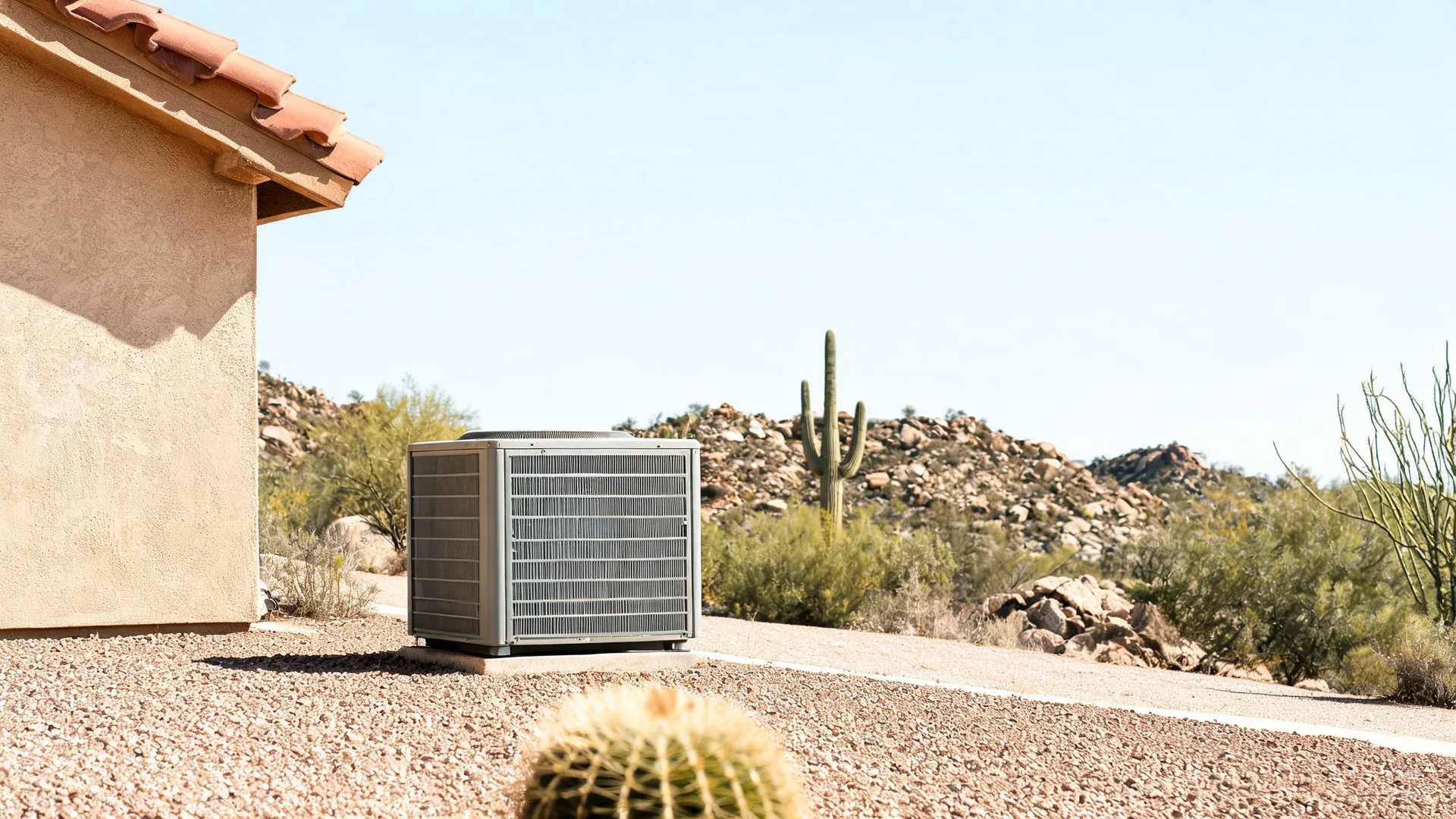
A residential heat pump outdoor unit mounted on a concrete pad next to a house with gray vinyl siding.

Running in both directions wears specific parts, not the whole system

A heat pump runs in both directions, cooling in summer and heating in winter, so the parts that start and stop it get used across the whole year, not just the cold months. The contactor that switches the compressor on and off pits and burns a little each time it closes. The run capacitor weakens over years of cycling until it can't give the compressor or fan motor the jolt they need to start, and the motor hums or stalls instead. The reversing valve, which flips the system between heating and cooling, can stick in one position after enough cycles. Outdoors, the fan motor bearings wear from sitting through rain, heat and cold alike. None of this points to the system as a whole. It's usually one part reaching the end of its life while the rest of the unit is fine.

What you'll notice first

A heat pump in trouble usually tells you before it quits outright. It runs but the air coming out doesn't feel warm. It cycles on and off every few minutes instead of running a steady stretch. The outdoor unit ices up and stays that way instead of clearing itself. Rooms that used to heat evenly now have cold spots. Any of these is worth a call, not a wait and see.

What the symptom doesn't tell you

The same complaint can point to different problems. Cold air can mean low refrigerant, a failing reversing valve, or a dirty filter choking airflow. Short cycling can be a bad capacitor or a thermostat sending the wrong signal. You can describe what you're hearing and feeling, but matching that to the actual part takes a tech with gauges and a meter, not a guess from the symptom alone.

A few things are worth checking before anyone comes out. Look at the thermostat first. Make sure it's set to heat, the temperature is actually above room temperature, and the batteries aren't dead if it uses them. Check your breaker panel for anything tripped, both the indoor and outdoor unit have their own. Walk outside and look at the unit itself. If it's buried in leaves, snow, or ice built up on the coil, that alone can stop it from working right. Check the air filter too. A filter clogged with dust chokes airflow and can make the system act like something's failing when it's just starved for air. None of this fixes a bad capacitor or a stuck reversing valve, but it rules out the simple stuff first.

A repair makes sense when the failure is one part doing one job. A contactor, a capacitor, a fan motor, a stuck reversing valve. Swap the part and the system runs the way it did before. Replacement starts to make sense when the compressor itself is damaged, since that's the part that actually moves refrigerant and the whole system depends on it. A cracked compressor or one that's seized isn't a repair so much as a reason to look at the whole unit. The other thing worth weighing is how many separate repairs a system has needed lately. One failure is a part wearing out on its own schedule. Several different parts failing over a short stretch is a pattern, and it's worth asking a tech whether the next part is likely to go too before you pay to fix the one in front of you.