A single-story dark shingled house with moss-covered roofs and a stone chimney, set behind a green lawn with ferns and shrubs, backed by tall conifer trees.

Heat Pump Maintenance in Vancouver, WA

Tell us about the job

Takes about a minute. No obligation.

Tune-up, service, or cleaningHeat PumpClark County, WA
Step 1 of 2

What ZIP code is the job in?

The signs are easy to miss

A heat pump in trouble doesn't usually quit outright. It runs longer than it used to, blows air that feels less warm or less cool than it should, or cycles on and off more than normal. Frost building up on the outdoor unit when it shouldn't be there, or ice that never clears during the defrost cycle, points to a problem with the reversing valve or the defrost control. None of these stop the system from running, so they get ignored until the day it actually fails.


Catching it early changes the job

A heat pump caught early usually means a technician cleans a coil, checks the refrigerant charge, or clears a clogged condensate line. Left alone, the same issue works the compressor harder every day it keeps running that way, and the compressor is the part that decides whether the system can be repaired at all. Checking it before the season it works hardest in gives a tech the chance to catch the small problem while it's still small.

A quick visit checks the thermostat setting and calls the job done.

A thorough one pulls the filter, washes the outdoor coil, checks the refrigerant charge, and tests the reversing valve, because a dirty coil or a low charge makes the compressor work harder every time the system runs.

One month of cooling, nine of heat, and a reversing valve that has to switch right both times

Cooling runs August through August
Heat runs October through June
2 damaging wind events from 2015 to 2024

Clark County doesn't put a heat pump through much. Winter lows average 35°F, mild enough that the system isn't straining against real cold most nights. Damaging wind and winter storms have hit the county over the past decade, but not often enough to count as a yearly beating. The wear here tends to come from age or a part that's been failing quietly, not from the load. A yearly check catches that early, before a small problem turns into a compressor replacement.

Half the homes here were built in 1993 or later

Half the homes in Clark County were built in 1993 or later. A system that age still has years left in it, and a yearly check is what keeps those years from getting cut short by a problem nobody caught.

Find a contractor
A man in a cap, gray long-sleeved shirt and brown work pants walks up concrete steps toward a dark blue front door, carrying a worn canvas tool bag beside a potted shrub.
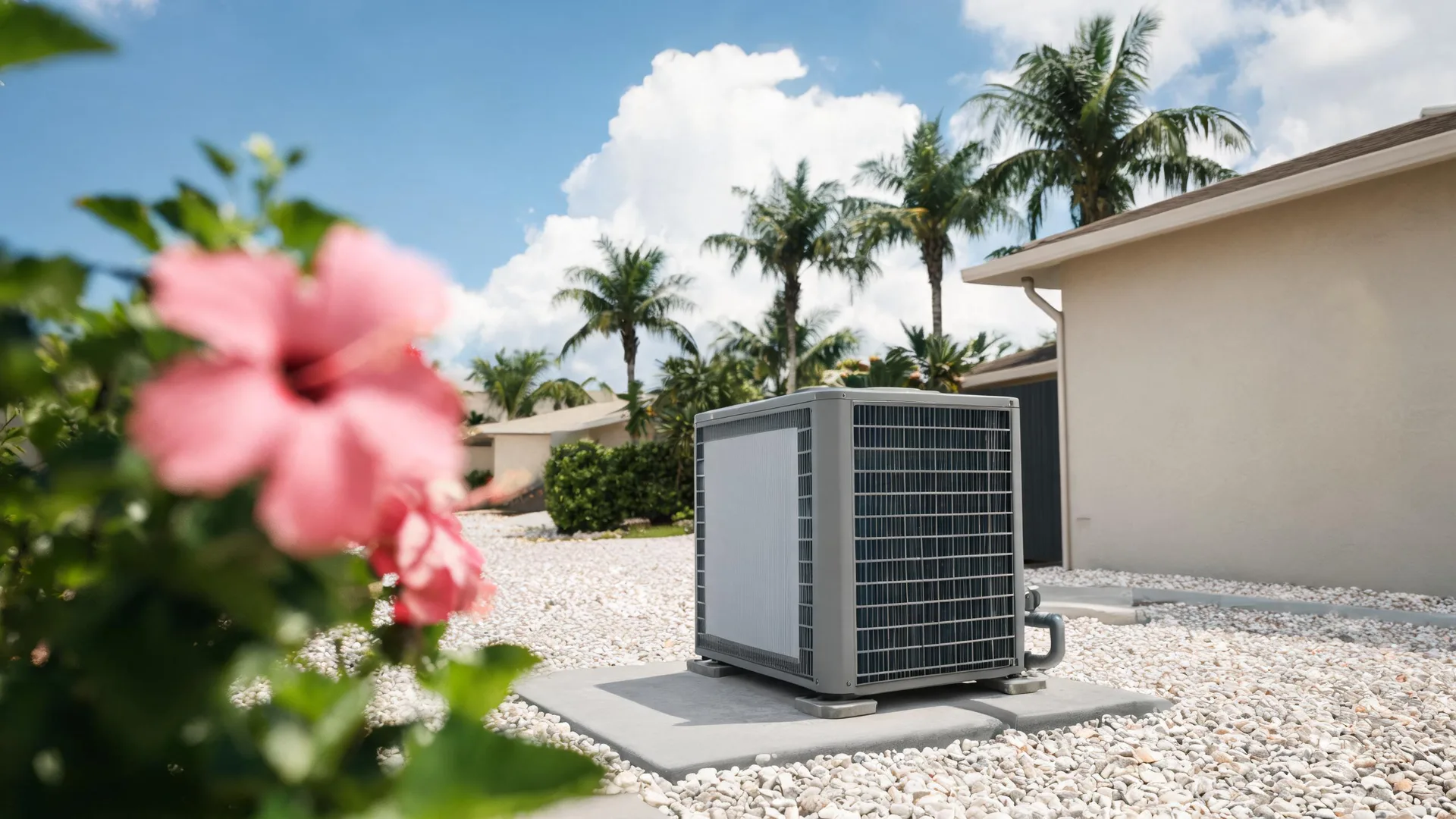
A gray heat pump outdoor unit mounted on a concrete pad next to the stone-accented exterior wall of a house.

The filter, the coils and the drain decide how hard the compressor works

A heat pump moves heat instead of making it, so both coils have to stay clean for that to work. The indoor coil sits right behind the filter, and a filter left in too long chokes off airflow until the coil can't pull heat the way it should. The system answers by running longer to get the same result, and that extra runtime falls on the compressor. The outdoor coil has the opposite problem. It sits outside catching leaves, grass clippings, cottonwood fluff, whatever blows against it, and nobody thinks to check it because it's not in the way like a dirty filter is. A coil caked with debris can't shed or absorb heat properly, so the system strains there too. The condensate drain gets overlooked even more. It carries away the moisture the indoor coil pulls out of the air, and when it clogs, water backs up into the cabinet or trips a safety switch that shuts the whole system down. None of these fail on a schedule. They foul up slowly, in the background, while the system keeps running and gives no sign anything is wrong until it works too hard for too long.

A static test finds a weak compressor before it quits

A technician checks amp draw on the compressor against what it should be pulling. Rising amp draw means it's working harder to do the same job, usually from a worn bearing or a start component going bad. Nothing about the way the system sounds or feels tells you this. The reading does.

Electrical connections loosen before they fail

Every wire nut and terminal in the unit gets a season of vibration from the compressor and fan running. A connection that's loosened enough adds resistance, and that resistance shows up as heat at the connection point. A tech checks these by hand and with a meter, tightening what's loose and looking for scorch marks that mean one already ran hot.

Between visits, the filter is the one thing worth checking yourself. Pull it out, hold it up to the light, and if you can't see through it, replace it or wash it if it's the reusable kind. Outside, keep the area around the unit clear so air can move through the coil, nothing stacked against it, no grass clippings piling up at the base. After mowing, a quick look to brush off anything stuck to the fins helps more than people think. If frost shows up on the outdoor unit and doesn't clear within an hour or so, that's not something to fix yourself, but it's worth noting when it happens and telling the technician at the next visit. Beyond that, leave the refrigerant, the electrical connections and the reversing valve alone. Those need a gauge or a meter to check safely, and opening the cabinet without one risks turning a small problem into a bigger one.

A proper tune-up starts before the panels come off. A technician checks the thermostat calls for heat and cooling correctly and that the system responds right away, not after a delay that points to a control problem. Refrigerant charge gets checked against the manufacturer's spec, because a system even a little low loses capacity and runs longer to make up for it. The reversing valve gets tested in both directions, since that's the part that decides whether the system heats or cools, and a valve that's slow to switch or stuck shows up here before it leaves anyone without heat. Electrical connections get checked for looseness and corrosion, and the capacitor gets tested rather than just looked at, because a capacitor can look fine and still be weak. The condensate drain gets cleared so it isn't carrying a clog into the season ahead. None of this takes long when the system is healthy. It takes longer, and finds more, when something's already been failing quietly.